
Quick answer: Who starts an Estonian company with Unicount? Founders from 99 different citizenships. About three in four are e-residents, and the rest are Estonian citizens. Since January 2025, 93% of new Unicount formations have been started by e-residents, led by France, Turkey, and Germany. One company in four is in IT and software. These Estonian company formation statistics come from Unicount’s own records of 1,900+ registered companies since 2019. They describe one provider’s clients, not the whole market.
Thinking about registering your own company? Talk to our team or see how Unicount company formation works.
Estonian company formation statistics at a glance
- Founders come from 99 citizenships. The ten largest account for 70% of formations: Estonia 26%, France 10%, Ukraine 8%, Turkey 7%, Russia 5%, Germany 4%, Spain 3%, the UK 3%, Italy 2% and India 2%. (Unicount data, October 2026)
- Three in four founders are e-residents. The remaining 26% are Estonian citizens. (Unicount data, October 2026)
- 93% of new formations since January 2025 are started by e-residents, up from 69% in 2019 to 2024. (Unicount data, October 2026)
- The mix is moving towards France, Turkey, and Germany. Since January 2025, France and Turkey are about 14% of new formations each, and Germany is 8%. (Unicount data, January 2025 to October 2026)
- One in four companies is registered in IT and software. Retail (15%) and management consulting (12%) follow. Together these three activities cover more than half of all formations. (Unicount data, October 2026)
- 27% of founders live in a different country from the one they hold citizenship of, which is why tax residency questions come up so often. (Unicount data, October 2026)
About this data
The figures come from an export of Unicount’s company formation records, taken on 27 October 2026. It covers companies whose formation was started between September 2019 and October 2026, and every one of them ended in a registered company. Four points matter when you quote it:
- “Formation” means a registered company. Applications that were never completed are not in the data.
- “E-resident” means a founder who is not an Estonian citizen. Unicount registers companies for founders who are Estonian citizens or who hold an e-Residency digital ID, so every founder who is not an Estonian citizen is an e-resident. The data records citizenship and country of residence as given at formation.
- Industry is the main activity declared at formation, recorded as an EMTAK code (Estonia’s version of the EU activity classification). A company’s real activity can change later.
- Figures are aggregates. We publish shares, not individual records, and only for groups large enough to report. Percentages are rounded, so they may not add up to exactly 100.
These definitions will stay the same in every report of the series so that the numbers can be compared over time.
Where do Unicount’s e-resident founders come from?
Founders in the data hold 99 different citizenships. The ten largest are listed below; the other 89 citizenships together make up the remaining 30%.
| Citizenship | Share of formations |
|---|---|
| Estonia | 25.7% |
| France | 10.3% |
| Ukraine | 7.8% |
| Turkey | 7.1% |
| Germany | 4.2% |
| Spain | 3.1% |
| United Kingdom | 2.6% |
| Italy | 2.1% |
| India | 2.1% |
Unicount data, October 2026. Citizenship as recorded at formation.
One in four founders is an Estonian citizen. That is a useful reminder that an Estonian company is not only a tool for people abroad: residents use it too. The other three quarters are e-residents from a wide spread of countries, with France and Ukraine leading and Turkey close behind.
How is the mix of founder countries changing?
The all-time table hides a clear change. Comparing formations from 2019 to 2024 with those from January 2025 to October 2026 shows that France, Turkey, Germany, Spain, and Italy have all grown as a share of new formations, while Estonian citizens and Ukraine have fallen back.
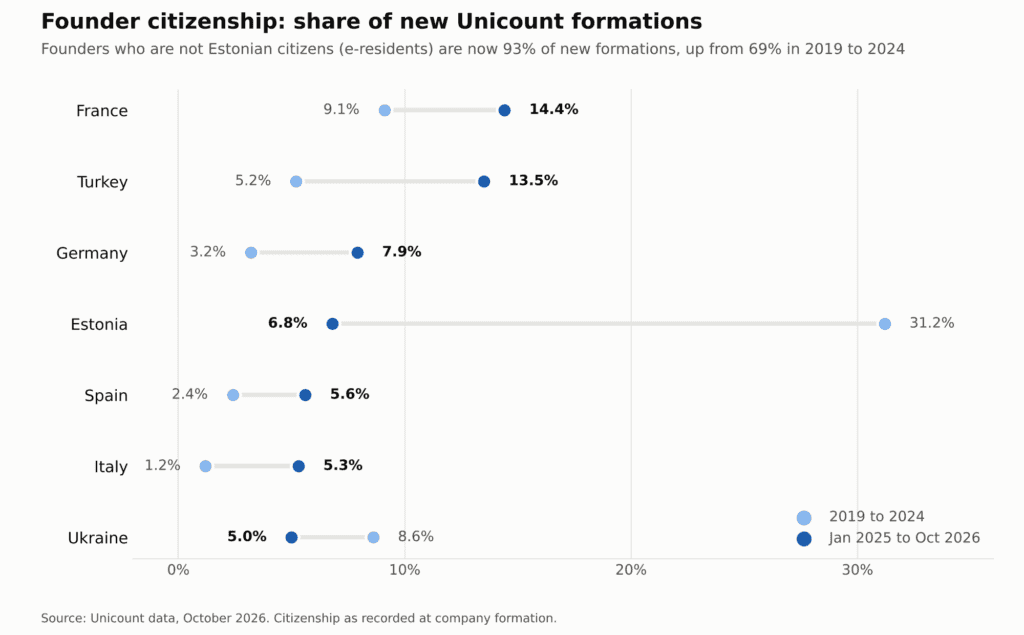
Dot chart of the share of new Unicount formations by founder citizenship, 2019 to 2024 versus January 2025 to October 2026
| Citizenship | 2019 to 2024 | January 2025 to October 2026 |
|---|---|---|
| France | 9.1% | 14.4% |
| Turkey | 5.2% | 13.5% |
| Germany | 3.2% | 7.9% |
| Estonia | 31.2% | 6.8% |
| Spain | 2.4% | 5.6% |
| Italy | 1.2% | 5.3% |
| Ukraine | 8.6% | 5.0% |
Unicount data, October 2026. Share of formations in each period.
Three readings are worth keeping in mind. First, these are shares, not volumes: a falling share does not mean fewer founders from that country. Second, the move towards France and Germany matches the wider picture: the e-Residency programme’s 2025 results list Germany (1,122), France (1,016), and Ukraine (921) as the largest countries of origin for new e-residents. Third, Turkey stands out. It is not among the programme’s top three, yet Turkish e-residents are about one in seven of Unicount’s recent formations. If you are in one of these groups, we have written country guides for France, Turkey, Germany, Spain, Italy, and the Netherlands.
Do e-residents live in the country they hold citizenship of?
Not always. For 27% of founders, the country of residence is different from the country of citizenship. French founders are the clearest example: French citizens are 10.3% of the formations, but only 7.5% of founders live in France. Turkey is the opposite case, with almost no gap (7.1% by citizenship, 6.9% by residence).
This matters for tax. Where you live, not which passport you hold, decides your personal tax residency, and it can also decide where your company is considered managed. Our guide: Can I live in Spain and own an Estonian company? walks through what that means in practice, and What AI gets wrong about Estonian companies explains why e-Residency itself does not change your tax residency.
Which industries do founders start in?
Founders were asked for the main activity of the company at formation. Three activities dominate.
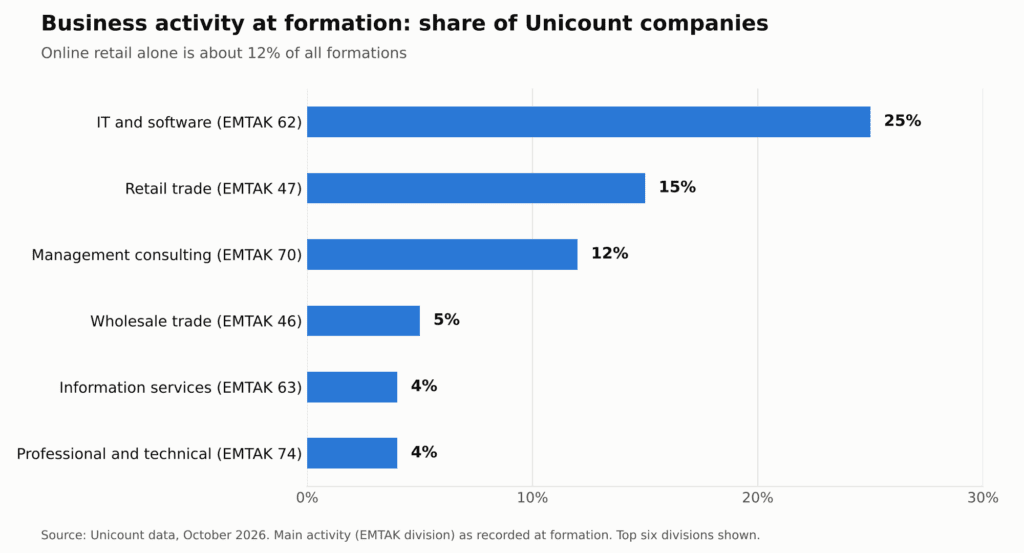
Bar chart of main business activity at formation: IT and software 25%, retail trade 15%, management consulting 12%, wholesale trade 5%, information services 4%, professional and technical 4%
| Main activity (EMTAK division) | Share of formations |
|---|---|
| IT and software (62) | 25% |
| Retail trade (47) | 15% |
| Management consulting (70) | 12% |
| Wholesale trade (46) | 5% |
| Information services (63) | 4% |
| Professional and technical activities (74) | 4% |
Unicount data, October 2026. Top six EMTAK divisions. Main activity as recorded at formation.
IT and software is the largest single group, at one in four companies. Online retail on its own (EMTAK 47911) is about 12% of all formations, which is most of the retail share. Management consulting is third. In short, the typical Unicount company sells software, services, or products online to customers in other countries, which is the profile that benefits most from running a company remotely.
That profile also explains the questions founders ask us most. Service and software businesses often invoice clients outside the EU, covered in Can I invoice US clients from my Estonian company?. Online retailers need to understand VAT and OSS, covered in our VAT guide. And for any of them, the real running cost is worth checking in How much does an Estonian company actually cost?.
What will the next reports cover?
Report #1 covers who forms companies and in which industries. Later reports will look at what happens after registration, starting with VAT registration, dormant companies, and the most common accounting mistakes, as the data becomes available. Each report will use the same definitions as this one.
How to cite this data
You are welcome to quote and reuse these figures with attribution and a link.
Unicount (2026). What Unicount’s clients tell us: Estonian company formation statistics, Report #1. https://unicount.eu/en/what-unicount-clients-tell-us-report-1/
Journalists and researchers who need context or a different cut of the data can contact us.
Frequently asked questions
Where do Unicount’s founders come from? The founders hold 99 different citizenships. The ten largest are Estonia (26%), France (10%), Ukraine (8%), Turkey (7%), Germany (4%), Spain (3%), the UK (3%), Italy (2%), and India (2%), together accounting for 70% of formations. (Unicount data, October 2026)
What share of Unicount’s founders are e-residents? About three in four. Every founder who is not an Estonian citizen registers with an e-Residency digital ID, and Estonian citizens are 26% of all formations. Since January 2025, e-residents are 93% of new formations, up from 69% in 2019 to 2024. (Unicount data, October 2026)
Which countries are growing fastest among Unicount’s founders? Since January 2025, France (14.4% of new formations) and Turkey (13.5%) lead, followed by Germany (7.9%), Spain (5.6%), and Italy (5.3%). Estonian citizens fell from 31.2% of formations in 2019 to 2024 to 6.8% since January 2025. (Unicount data, October 2026)
What kinds of companies do founders register? The largest group is IT and software at 25% of formations, followed by retail trade at 15% (online retail alone is about 12%) and management consulting at 12%. These three activities together cover more than half of all formations. (Unicount data, October 2026)
Do e-residents live in the country they hold citizenship of? Mostly, but not always. For 27% of Unicount’s founders, the country of residence differs from the country of citizenship. French citizens are 10.3% of the formations, but only 7.5% of founders live in France. (Unicount data, October 2026)
Does the data cover all Estonian companies? No. It describes companies formed with Unicount between September 2019 and October 2026 and only completed formations. It is one provider’s data, not a market-wide count.
Can I quote this data? Yes, with attribution and a link to this page. See “How to cite this data” above.
Internal links used
- How Unicount company formation works
- Country guides: France, Turkey, Germany, Spain, Italy, Netherlands
- Can I live in Spain and own an Estonian company?
- What AI gets wrong about Estonian companies
- Can I invoice US clients from my Estonian company?
- VAT guide
- How much does an Estonian company actually cost?
- Contact page
External sources
This report presents aggregated data from Unicount’s own company formation records and is for informational purposes only. It describes Unicount’s clients, not all Estonian companies or all e-residents, and it does not constitute legal or tax advice. Individual circumstances vary.
Data as of October 2026. Last verified: October 2026 by Unicount team.